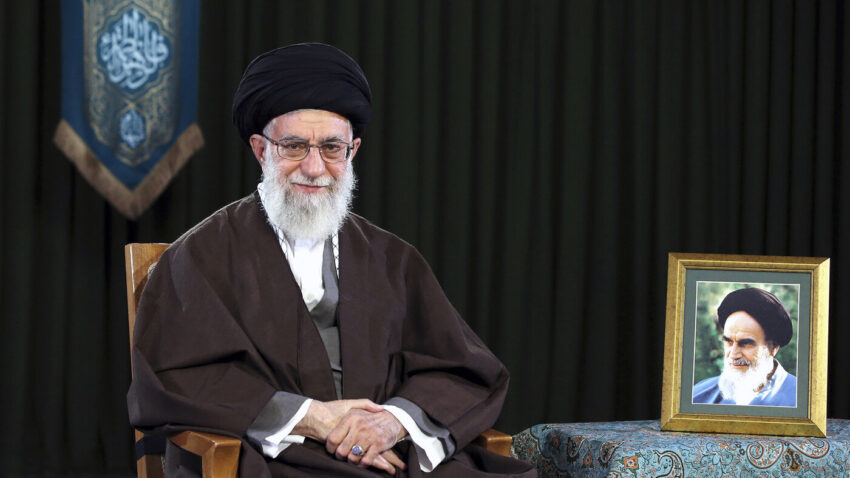
Iran’s supreme leader, Ayatollah Ali Khamenei, was reportedly killed in Israeli attacks, with U.S. support, on Saturday. He was 86 years old. President Trump announced the Iranian leader’s death on social media, stating that Khamenei could not avoid U.S. intelligence and surveillance. A source briefed on the U.S.-Israeli attacks on Iran told NPR earlier that an Israeli airstrike was responsible for Khamenei’s death.
During his 36-year rule, Khamenei remained unwavering in his staunch antipathy towards the U.S. and Israel, as well as against any efforts to reform and bring Iran into the 21st century.
### Early Life and Rise to Power
Khamenei was born in July 1939 into a religious family in the Shia Muslim holy city of Mashhad, in northeastern Iran. He attended theological school and became an outspoken opponent of the U.S.-backed Shah Mohammad Reza Pahlavi. Khamenei was arrested several times during this period and was closely associated with other Iranian activists, including Ayatollah Ruhollah Khomeini, who became Iran’s first supreme leader following the Islamic Revolution in the late 1970s.
In 1981, Khamenei survived an assassination attempt that resulted in the loss of use of his right arm. He served as Iran’s president before succeeding Khomeini as supreme leader in 1989.
### Ascending to Supreme Leadership
Alex Vatanka, a senior fellow at the Middle East Institute in Washington, D.C., described Khamenei as an unlikely candidate for supreme leader. Then a mid-level cleric, Khamenei lacked the religious credentials and gravitas expected to succeed the founder of the Islamic Republic, Ayatollah Khomeini.
“He spent the first few years in power being very nervous,” Vatanka explains. “He literally felt someone was going to take him down from the position of power.”
However, Khamenei was cunning and eventually outwitted other senior political figures in the Islamic Republic. According to Ali Vaez, director of the Iran Project at the International Crisis Group, with the backing of the formidable Islamic Revolutionary Guard Corps (IRGC), Khamenei built a powerful base that made him the longest-serving leader in the Middle East.
“Ayatollah Khamenei was a man of strategic patience who could calculate several steps ahead,” Vaez says. “With the support of the Revolutionary Guards, he appropriated all the levers of power and sidelined everyone else.”
### Consolidation of Power and Influence
Thanks to his close ties with the Revolutionary Guards, Iran’s military developed a vast commercial empire controlling many parts of the economy, while many ordinary Iranians continued to struggle economically. Khamenei also strengthened Iran’s defensive strategies by supporting proxy groups like Hezbollah in Lebanon and Hamas in the Gaza Strip, aiming to deter direct attacks on Iranian soil.
As supreme leader, Khamenei had the final say on Iran’s nuclear program. Over time, he increasingly involved himself in politics, notably intervening in the 2009 presidential election to ensure the victory of his preferred candidate, conservative Mahmoud Ahmadinejad.
The disputed election sparked large-scale protests across Iran, which Khamenei brutally suppressed, triggering ongoing backlash and repeated protest movements.
### Crackdowns and Domestic Turmoil
Under Khamenei’s rule, thousands were killed in government crackdowns on dissent, including more than 7,000 people during weeks of mass protests that began in late December 2025, according to the Human Rights Activists News Agency, a U.S.-based monitoring organization.
“Khamenei consistently supported and endorsed harsh government crackdowns, recognizing that these protests threatened state stability and legitimacy,” says Sanam Vakil, an Iran expert at Chatham House in London.
However, Khamenei showed little interest in addressing the root causes of the unrest. Vatanka notes that the Supreme Leader remained trapped in an Islamic revolutionary mindset, refusing to acknowledge the changing views of much of Iran’s population.
“About 75% of Iran’s 90 million people were born after the revolution and have seen other regional countries modernize and integrate internationally,” Vatanka explains. “He failed miserably to cater to their aspirations and listen to them.”
### Challenges to the Regime
Following the Arab Spring uprisings of 2011, Khamenei grew increasingly concerned about the regime’s survival. The Iranian economy was collapsing, largely due to harsh Western sanctions, fueling more unrest.
In 2013, Khamenei agreed to secret negotiations with the U.S. on Iran’s nuclear program, culminating in the 2015 Joint Comprehensive Plan of Action (JCPOA). Nonetheless, Vaez says Khamenei remained deeply distrustful of the U.S. and skeptical about the deal.
“His argument was that the U.S. would look for any pretext to pressure Iran—whether over missiles, human rights, or regional policies,” Vaez says.
President Trump’s withdrawal from the nuclear deal during his first term appeared to validate Khamenei’s cynicism, with Iran increasing nuclear enrichment to levels close to bomb-grade.
### Escalation of Conflict
In early 2025, when Trump sought to reopen negotiations, Khamenei delayed talks until mid-April, but time ran out. In June, Israel launched attacks aimed at neutralizing Iran’s nuclear program, targeting key facilities and killing scientists and generals.
Iran retaliated, prompting several days of missile exchanges. On June 21, 2025, the U.S. conducted major airstrikes on three of Iran’s nuclear enrichment sites. Trump declared these facilities “completely and totally obliterated,” though debates persisted regarding the actual impact.
Vakil believes Khamenei underestimated the resolve of Israel and the U.S. He says, “Khamenei assumed he could play for time, but the world had changed. The global community had grown tired of Iranian foot-dragging, which was a miscalculation on his part.”
### Proxy Conflicts and Downfall
Iran’s proxy militias played a crucial role in Khamenei’s downfall. When Iran-backed Hamas attacked Israel on October 7, 2023, killing nearly 1,200 people and kidnapping 251, it set off a chain reaction.
The next day, Iran-backed Hezbollah in Lebanon fired rockets into Israel, triggering a conflict that severely weakened Hezbollah’s leadership, including top leader Hassan Nasrallah.
In 2024, Israel and Iran exchanged direct airstrikes for the first time. Israeli bombing of Iranian weapons shipments in Syria further weakened the regime of Syrian dictator Bashar al-Assad, a key Iranian ally. Assad fell in December 2024 and fled to Russia in early 2025.
### Legacy and Future Uncertainty
By the time of Khamenei’s death, his legacy was in ruins. Israel had severely damaged two of Iran’s main proxies, Hamas and Hezbollah, and destroyed much of Iran’s air defenses. With U.S. assistance, Iran’s nuclear program was left in shambles, though its robust ballistic missile program—Khamenei’s brainchild—remained intact.
The future leadership of Iran is unclear, with the country weakened and vulnerable after decades under Khamenei’s rule.
https://www.npr.org/2026/02/28/1123499337/iran-israel-ayatollah-ali-khamenei-killed